

We are B-Corp Certified
Changing people's perspective on the fact that clothes are valuable objects. Our values reconnect us with love and respect for a long-term wardrobe in natural fibres, worthy of mending and repair, and contribute to a positive change.
Explainer
What is B-corp?
The B-corp is known to be one of the most rigorous certifications in the world. It is obtained by companies in all industries that meet the highest standards of verified social and environmental performance, transparency and accountability.
The B-corp certification is one of the only truly holistic certifications in the world - this ensures that the certified companies are sure and verified to be transparent, responsible and sustainable all around, and in everything they do.
This means that all aspiring companies are measured on their impact on areas such as their business model, the work environment within the company as well as the environmental impact and footprint the company leaves.
When you as a consumer encounter the B-corp certificate, you can be safe and sure that the given company lives up to the highest environmental as well as social standards.
For Proem Parades, obtaining the B-corp certification is a prove that we do business with a higher purpose - to benefit all people, communities and ultimately, the planet.


Our Commitments
Proem Parades engages in lobbying and advocacy only in ways that contribute to positive social and environmental impact, in line with the B Lab Standards and the UN Sustainable Development Goals. Our positions are based on reliable and where possible scientifically grounded data.
We do not make financial or in-kind contributions to political parties, candidates, or campaigns. We do not engage in bribery, corruption, or undue influence.
When we participate in organisations that engage in lobbying on our behalf, we assess whether their positions align with this policy. Where misalignment cannot be resolved, we will publicly clarify our own position and, if necessary, end the relationship.
Stakeholders may raise concerns about our lobbying activities through our grievance mechanism at https://proem-parades.com/pages/grievance-mechanism
This policy has been approved by governing body and is reviewed annually by founders.
At Proem Parades, we strive to act responsibly in both the daily operation and future development of our company. Respect for human rights is integral to our purpose and guides our decisions about the clients, projects, and partners we work with. Hence, we are committed to working actively respecting the human rights of all individuals and communities affected by our operations and value chain and working in a systematic and dedicated way with due diligence.
We align our approach with internationally recognized standards, including the UN Guiding Principles on Business and Human Rights, the International Bill of Human Rights (and the rights under the Universal Declaration of Human Rights), and the International Labour Organization’s Declaration on Fundamental Principles and Rights at Work.
This commitment applies to all people connected to our business, including our workers, clients, partners, suppliers, and the communities where we operate, regardless of location.
We will achieve our human rights commitment by integrating sustainability due diligence into our operations based on the internationally recognized principles mentioned above. This includes human rights, labor rights, the environment including both climate and biodiversity, and anti-corruption. In our due diligence efforts, we will conduct a risk mapping in the entire value chain and assess where we, as a company, have the most significant actual or potential negative impacts on people, the environment, and society. In implementing sustainability due diligence, we will engage our suppliers and other relevant organizations and stakeholders for insights, feedback and mitigation of risks.
We seek to prevent, mitigate, and remediate negative human rights impacts linked to our activities, products, services, and business relationships.
This includes:
- Providing fair and safe working conditions, free from discrimination, harassment, and abuse.
- Respecting freedom of association and the right to collective bargaining where applicable.
- Avoiding complicity in human rights abuses in our value chain and business relationships.
- Listening and responding to concerns raised by workers, clients, communities, and other stakeholders.
For a fashion company, the vast majority of greenhouse gas emissions occur before a garment ever reaches the customer. Scope 3 emissions typically account for 80–90% of a fashion brand's total carbon footprint. This means that the most meaningful climate action we can take is not in our office or our packaging, but in the choices we make at the design table: which materials we specify, which suppliers we work with, and how long we intend our garments to last. This does NOT mean that we do not care about Scope 1 and 2, but this knowledge is one of the key drivers for our vision with Proem Parades.
At Proem Parades, we recognise that durability is climate action. Longevity, quality, and timeless design are not just aesthetic values, they are our most direct contribution to reducing the environmental cost of what we make. Alongside is pre-order production, trying to reduce the amount of waste in the industry.
Scope of Emissions
We organise our emissions according to the three scopes defined by the GHG Protocol.
Scope 1: Direct emissions
Emissions from sources we own or control directly. For Proem Parades, this is minimal, we do not operate factories or a vehicle fleet. It primarily covers any gas or fuel used at our office.
Scope 2: Indirect energy emissions
Emissions from the electricity and heating we purchase for our office and storage. We are committed to sourcing renewable energy where possible.
Scope 3: Value chain emissions
This is where our real impact lies. Scope 3 covers everything outside our direct control. For us, the most significant categories are:
Raw material production: the growing, extracting, or synthesising of fibres
Manufacturing and processing: spinning, weaving, dyeing, and garment construction, primarily carried out by our production partners
Transport and freight: moving materials and finished goods across borders
Packaging: the production of all packaging materials we use
Product use and end of life: washing, wearing, and eventual disposal of garments by the customer.
We haven’t yet completed a full greenhouse gas inventory, we are currently in the process of mapping our full Scope 3 footprint to establish a reliable baseline. Until that baseline is in place, our primary focus is on reducing impact where we know it to be greatest: material choice and supplier engagement. The goal is to be able to map our footprint of Scope 3 within year 2029. We are a small company so we must take it step by step.
Supply Chain Commitment
Our supply chain is where most of our environmental and social impact occurs. We take this seriously, not as a compliance exercise, but as a core part of how we build the brand.
Supplier relationships
We work with a small, deliberate number of production partners. We prioritise long-term relationships over short-term price advantages, because longevity in supplier partnerships is the foundation for meaningful improvement, both when it comes to finding the best sustainable solutions as well as financially. We have worked with 90% of our suppliers for the last 6 years and visited most of them.
What we ask of suppliers
We expect our suppliers to meet minimum standards on environmental management, working conditions, and legal compliance. Where relevant, we ask for documentation including certifications, audit reports, and chemical compliance records. Formalized in our Code of Conduct.
Material sourcing
We prioritise materials with credible third-party certification such as GOTS (Global Organic Textile Standard), OEKO-TEX, or equivalent and we are actively working to increase the share of certified sustainable fibres across our collections. We avoid materials with known high environmental costs where alternatives exist. We almost only work with natural fibres and only allow the use of synthetic fibers in some fabrics to be maximum of 8%.
In approximately 99% of our products only natural fibers are used. This is why:
High quality natural fibres last longer, directly reducing the per-wear carbon footprint.
At end of life, they biodegrade, synthetics fragment into microplastics that persist for hundreds of years. Every wash of a synthetic garment releases microplastics into the water system, natural fibres do not. Pure natural fibres are compatible with textile recycling, blends and synthetics largely are not. The commitment must be to quality: a well-constructed linen or merino wool justifies its environmental cost through years of use. We strive to use high quality fibers and fabrics.
Natural fibres connect the garment to land, seasons, and the people who grow them, relevant to both environmental and social responsibility. We strive always to use monofibers, so the recyclability is possible.
Transparency and traceability
We are committed to knowing where our materials come from. We are building a clearer picture of our tier 1 and tier 2 suppliers and intend to increase traceability as our tools and supplier relationships develop.
Continuous improvement
We do not expect perfection from our suppliers, we expect progress, transparency and honesty. Where we identify issues, our first response is dialogue and support, not disengagement. We believe that staying in a relationship and pushing for improvement has more impact than walking away.
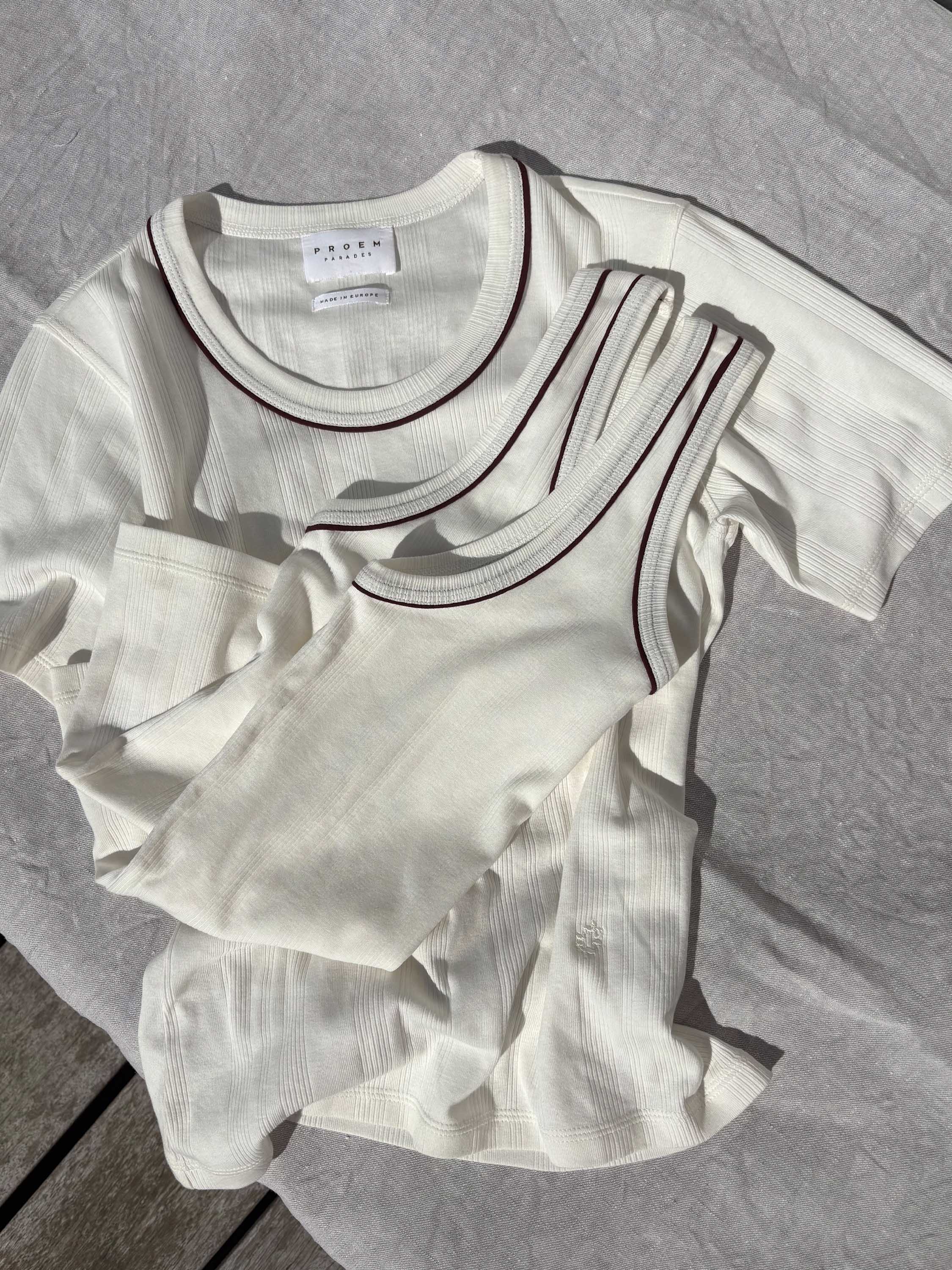
We design for longevity over trend. We choose high quality natural monofibres where possible, prioritising certified materials with credible third-party standards. We finish garments as carefully on the inside as on the outside because a well-made garment gets worn more, kept longer, and replaced less.
We avoid unnecessary blends, excess hardware, and decorative elements that complicate recycling or shorten a garment's useful life. Simplicity in construction is a sustainability position.
Our goal is a wardrobe of pieces that outlast the season they were made for. Through our Parades events we pioneer this belief and educate the consumer to make responsible decisions when purchasing clothing.
Transport and Logistics
We use air freight as little as possible, and are actively working to reduce our dependency on it. For some shipments it remains a practical reality, and we are honest about that. Within Europe, we default to train or truck for all movement of goods and for business travel.
We consolidate shipments where we can, reducing the number of individual movements across our supply chain. We are working towards a clearer picture of our total transport emissions as part of our Scope 3 mapping.
For business travel, we default to train over plane for European destinations. However sometimes only planes are realistic, but we have a policy of no more than two air flights per person (only two persons) per year.
Packaging
We keep packaging to a minimum. What we do use is either FSC-certified or made from recycled materials, we do not use virgin paper or cardboard where alternatives exist. We avoid plastic in our packaging wherever possible, and where it does appear we are actively working to eliminate it.
We believe the best packaging is as little as necessary, and as responsible as possible.
Offsetting and Compensation
At the moment we do not have any offsetting or compensation processes, but here is our policy. We view carbon offsetting as a last resort, not a solution. Offsetting does not undo emissions, it compensates for them, and we are cautious about using it as a reason to move more slowly on the reductions that actually matter.
Our priority is to reduce emissions at source. Where residual emissions remain that we cannot yet eliminate and we are honest that there will be some, we are open to supporting credible offsetting programmes as a temporary measure. We will only work with verified schemes that meet recognised standards such as Gold Standard or Verified Carbon Standard (VCS).
We will not use offsetting to make climate claims we have not earned.
Measuring and Reporting
We use the GHG Protocol as our framework for measuring and categorising emissions. We are currently in the process of completing our first full carbon mapping, establishing the baseline from which all future progress will be measured.
We report on climate progress internally on an annual basis, and externally through our B Corp assessment and on our website. We commit to being honest in that reporting including about the areas where we are not yet where we want to be.
We would rather show real progress slowly than present a polished picture that does not reflect reality.
- We act against discrimination and systemic inequalities and treat all people with dignity and respect, regardless of background, identity or affiliation.
- We create inclusive and safe working environments and collaborations where diverse perspectives are heard and taken seriously.
- We engage relevant stakeholders (employees, partners, suppliers and others) and use their feedback when we choose and develop our actions.
- We review key policies and practices through a and human rights lens and update them where they create barriers or inequality.
In practice, our actions include that we will:
- Recruit through inclusive, skills-based job descriptions and structured interviews that reduce bias and broaden our candidate pool.
- Work toward fair and transparent pay, including regular pay reviews and clear criteria for roles and progression.
- Provide diversity and anti-bias training for everyone at Proem Parades, including leadership
- set concrete, measurable diversity goals each year and assign clear ownership for following up on them.
- Make our workplaces, events, and communications accessible – physically and digitally – and reflect diverse communities in the Parades and projects we create.
- Prioritize local, minority-, women-, and social-enterprise-owned suppliers where comparable, and track our progress over time. In the end we must run a financial sustainable business, but we will always look at the possibilities for prioritising minorities.This commitment applies to all individuals and communities affected by Proem Parades’ activities and value chain. If you experience breaches on our commitments to Human Rights and principles, please contact us using our Grievance Mechanism.
